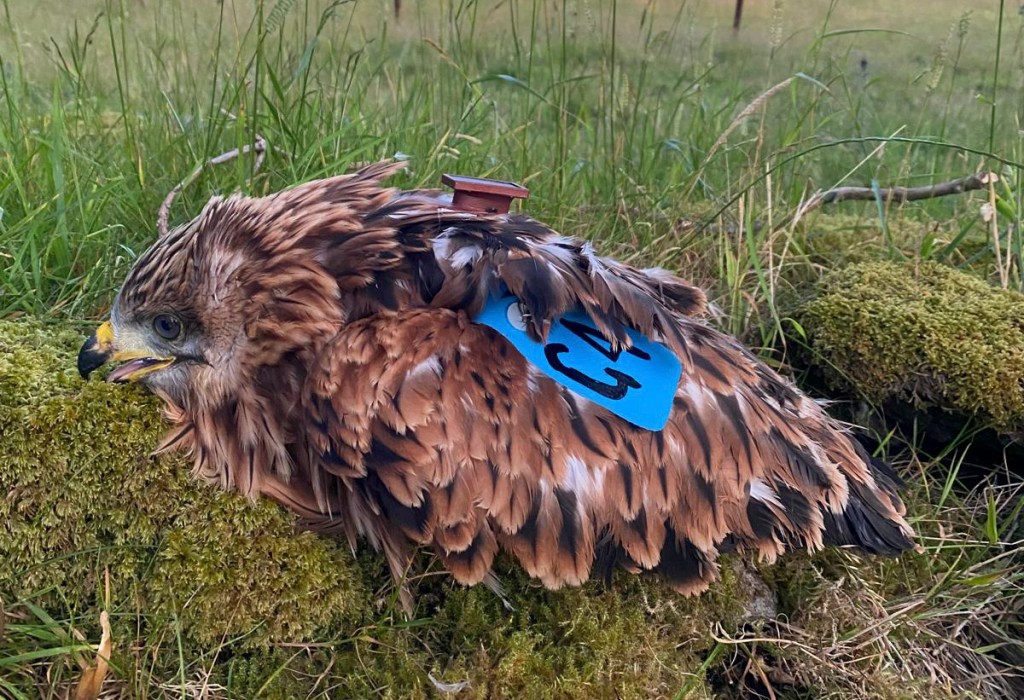
This is the story of ‘Orlagh’, a Red Kite born in Co. Wicklow in 2023. Orlagh was tagged, under licence, with a GPS-tracker, funded through the Golden Eagle Trust and NIRSG Hawk Eyes Programme, as part of the cross-border ‘Hawk-Eyes’ project which studies the lives and movements of these birds. Like most Red Kites, Orlagh roamed widely in her first 18 months. She went as far as the south-east of Cork, and to the Armagh border in the north.
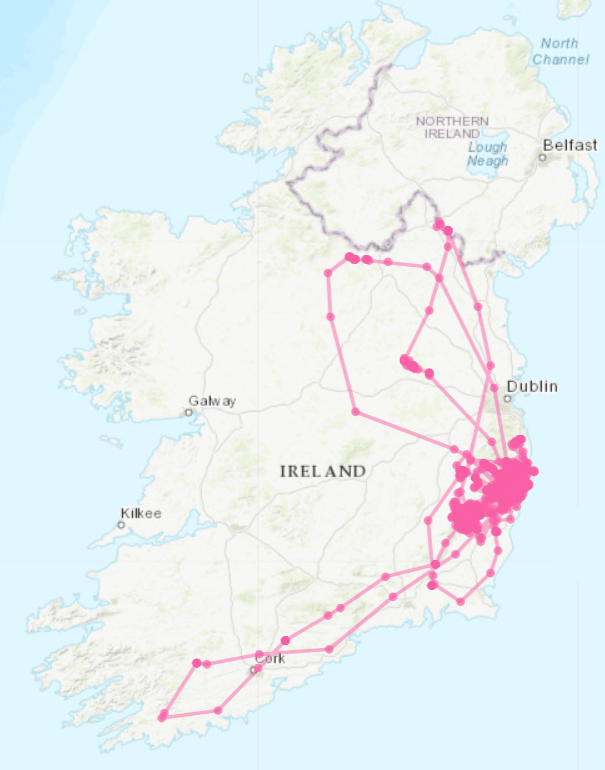
What was extra incredible about Orlagh was that she settled in Co. Carlow in late winter 2024 and in 2025 she attempted to nest – the first recorded nesting of a Red Kite in Co. Carlow in over 300 years. A pioneer! We were elated to see the spread of the population away from the stronghold in Co. Wicklow. Although she failed in her first breeding attempt, as many young red kites do (there is a lot to learn!), we were still very hopeful that she would maintain that territory and try again.
We watched the daily data from her tracker and after initially travelling to Avoca, Co. Wicklow (a strong-hold for Red Kites), in late June, she returned and continued to hold territory in Co. Carlow throughout late winter 2025. We were delighted to see the tracker record repeated back-and-forth visiting of the nest in March 2026 – she was going to try again! Lots of coming and going to the nest site in March suddenly stopped on the 24th March. Closer examination of the data retrieved by the satellite-tag showed that her body temperature was dropping and it was in an unnatural position.
We contacted the National Parks and Wildlife Service (NPWS) who immediately sent a Ranger to search for the bird. Unfortunately, our fears were confirmed when Orlagh was found dead, not far from her nest. She was sent for post-mortem and toxicology testing and we awaited the outcome. Could it have been avian flu or some other illness? Had she collided with a car or electricity wires? When the results came back from the lab we were shocked, but not surprised. Her death was due to the evil intentions of a human; she had died from consuming a poisoned bait laced with an illegal pesticide, carbofuran, which had been left in the open countryside.
Carbofuran is a pesticide sold under brand names such as Curaterr ® and Furadan ® 75. The safety data sheet reads ‘fatal if swallowed… fatal if inhaled… causes damage to organs…may be harmful in contact with skin…may cause cancer…may form combustible dust concentrations in air.’ In the European Union, authorisation for plant protection products (‘pesticides’) to contain Carbofuran was withdrawn by December 2007 and the pesticide has been completely banned for use since 2009. So why is it still killing our birds of prey in Ireland in 2026?
People setting poisoned baits in the countryside need to wise up. The practice is long outdated and has been illegal in Ireland since 2010 and illegal in Northern Ireland since 1985. It is extremely dangerous, not only to wildlife but to people, pets and livestock too. And it is lazy, selfish and ignorant. The actions of one individual have denied Co. Carlow of a pioneer of an ancient species once lost from this island and welcomed back as a native part of our heritage. A key contributor to pest control and nutrient recycling.
We commend the NPWS on their rapid response and recovery of the kite for testing. The reality is that often these birds are found in remote areas and without tracking devices and we rely on information from the public and landowners to understand the circumstances which led to the death of these birds. We urge anyone with information about poisons being used to contact the authorities. This red kite lost it life but it has raised awareness of these horrendous chemicals still being used in our countryside.
The press release from NPWS can be seen here https://www.rte.ie/news/regional/2026/1021/1596338-red-kite-carlow/
If you have any information, or you come across a bait or dead or dying birds of prey, please contact the NPWS in the Republic of Ireland. In Northern Ireland you can call PSNI on 101 or use Crimestoppers to report anonymously on 0800 555 111.