
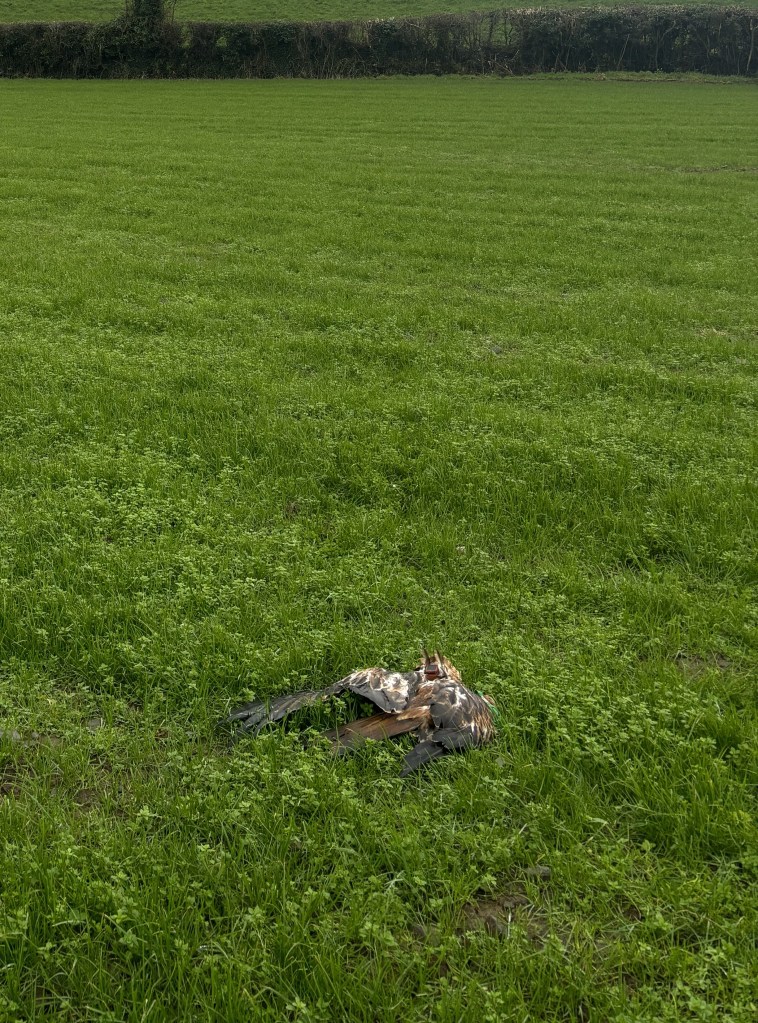
Police have confirmed that a Red Kite found in December on the Tullymore Road, close to the A1 between Newry and Banbridge, was poisoned. The bird of prey, only 8-months old, was part of a state of the art tracking project known as ‘Hawk-Eyes’. The movements of the bird were recorded using GPS-satellite technology and are being used by PSNI as part of their investigation.
This latest revelation is in addition to two peregrine falcons and two ravens which PSNI have confirmed were poisoned in 2024.
Dr Eimear Rooney, Northern Ireland Raptor Study Group, said “The killing of birds of prey is illegal and is a global threat. Over half of our raptor species in Northern Ireland are on the Red or Amber List of conservation concern and over 50% of raptor species are declining globally. There is no legal reason to possess these poisons and, whatever the motive, their use is totally indiscriminate and completely illegal.” Dr Rooney added “To find this bird, lying dead in a field on Christmas Eve, was both heartbreaking and shocking. To think someone is using these poisons so close to where my children go to school is abhorrent, let alone the killing of wild animals in such a cruel way.”
The Northern Ireland Raptor Study Group (NIRSG), whose voluntary members monitor birds of prey across Northen Ireland, highlight that robust post-mortem and laboratory results have proven that 63 raptors have been killed between 2009 and 2023 with a range of banned pesticides, dominated by Carbofuran which has been banned for nearly 25 years. There have been at least 30 buzzards, 16 peregrine falcons, 13 red kites, 3 white tailed eagles and 1 golden eagle all confirmed poisoned in this time frame. In addition to these, testing has confirmed the poisoning of 18 cats and 6 dogs in this same period.
Dr Rooney, co-author of the Raptor Persecution and Poisoning Reports in Northern Ireland, said “We know that the raptors confirmed poisoned are only the tip of the iceberg. These incidents occur in remote areas and birds are often too decomposed for testing. That is where GPS-technology has a role to play. Through ‘Hawk-Eyes’ we can follow the movements of the birds and act quickly if movements stop suddenly.”
Dr Marc Ruddock, NIRSG, said “Wildlife crime, including poisoning, is investigated by the PSNI under the Wildlife (Northern Ireland) Order 1985, as amended. In 2011, the wildlife legislation in Northern Ireland was strengthened, resulting in increased sentences of £5,000 fines (per offence) and up to 6 months imprisonment. The updated laws included a provision make the possession of prescribed ingredients unlawful under “Section 15B Possession of pesticides harmful to wildlife”. As part of that legislation there should have been an attached Order listing the banned chemicals. That list has never been created, and wildlife has continued to be poisoned by these dangerous and banned substances.”
The NIRSG, RSPB NI and Ulster Wildlife have called jointly upon the Minister for Agriculture, Environment and Rural Affairs, Minister Andrew Muir MLA, to implement ‘The Possession of Pesticides harmful to wildlife (Northern Ireland) Order’, whereby it would be an offence under the Wildlife Order to possess these banned pesticides. They met with the Minister earlier this week and presented a petition calling for an update in the legislation, which has been signed by over 50,000 people.

Dr Ruddock explained “We are seeking an urgent review of the legislation surrounding the possession of banned pesticides which are used to illegally kill wildlife in Northern Ireland. If a pesticide has already been banned for use on the basis of its toxicity and threat to humans, wildlife and the wider environment, there can be no justification for keeping it. Over 50,000 people have shown they agree with us by signing our petition on the matter. We thank everyone who has done so and helped give a voice to our wildlife. It is now up to the Minister and his department to agree that it is expedient to implement this Order to protect our birds of prey from harm and to take action”
Dr Ruddock added “Non-approved pesticides are not just a threat to wildlife and the wider environment; many of them can have fatal consequences for any human (adult or child) who happens to inadvertently come into contact with them, for example by touching a poisonous bait laid out in the countryside. These poisons can be absorbed through the skin. If you find a dead animal in suspicious circumstances please do not touch it and call PSNI on the non-emergency number 101.
Any information on this case call be reported to PSNI by using reference 419. 24/12/24 or can be reported anonymously via Crimestoppers on 0800 555 333.
Notes for editors:
- A link to the petition is here
- The Partnership for Action Against Wildlife Crime in Northern Ireland (PAWNI) published regular reports on bird of prey persecution – the latest is here
- Photos are available at the following link here showing representatives from the NIRSG, RSPB and Ulster Wildlife at Stormont and also meeting Minister Muir to hand over the petition containing over 50,000 signatures.
 Hawk-Eyes