
Thanks to additional funding received from the Environment Fund from Northern Ireland Environment Agency (NIEA) the Hawk-Eyes project continued to deploy satellite tags on some of our most persecuted species in Northern Ireland and the Republic of Ireland in 2024. Focus this year has been on Red Kites in particular.
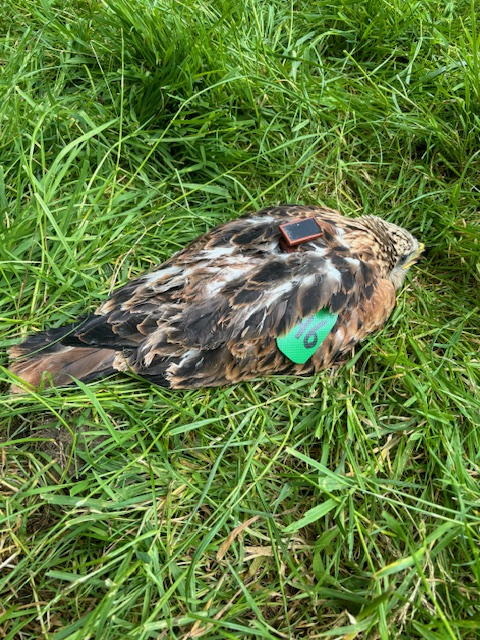
The dynamics (stability, growth or decline) of any population is based on the fundamentals of births, deaths, immigration and emigration. The red kite is a species which likes to breed close to other kites. They do not like to cross large bodies of water. The birds in the north west of the species’ European range tend not to migrate large distances. Therefore we can assume that immigration and emigration from localised populations occurs almost exclusively within the island of Ireland. In fact we know that some NI released / born birds are now breeding in ROI and vice versa, but these are in the single figures. Is there a greater linkage between the population in Northern Ireland and that in Co. Wicklow and north Dublin than we currently understand? Where will these young birds spend their first winter? Will they explore or remain settled?
We know that breeding success of nesting pairs is at or above average for the species across its range, so breeding pairs are doing well at producing young – but will these juveniles survive to reach breeding age?
These are some of the questions we aim to answer through the Hawk-Eyes project. Using state-of-the-art technology we have been tracking kites since 2019 and patterns are emerging. After an initial post-fledging period around the nest site some of these 2024 red kites really taking off! Some have explored as far as Co. Cork, Co. Kerry, Co. Donegal whilst others have not left Co. Down. So far the cohort of 2024 have already been in 22 counties! It is not a hard and fast rule that the young birds will explore widely though – we can see from the movements that red kites show individuality in their decisions to travel or not.
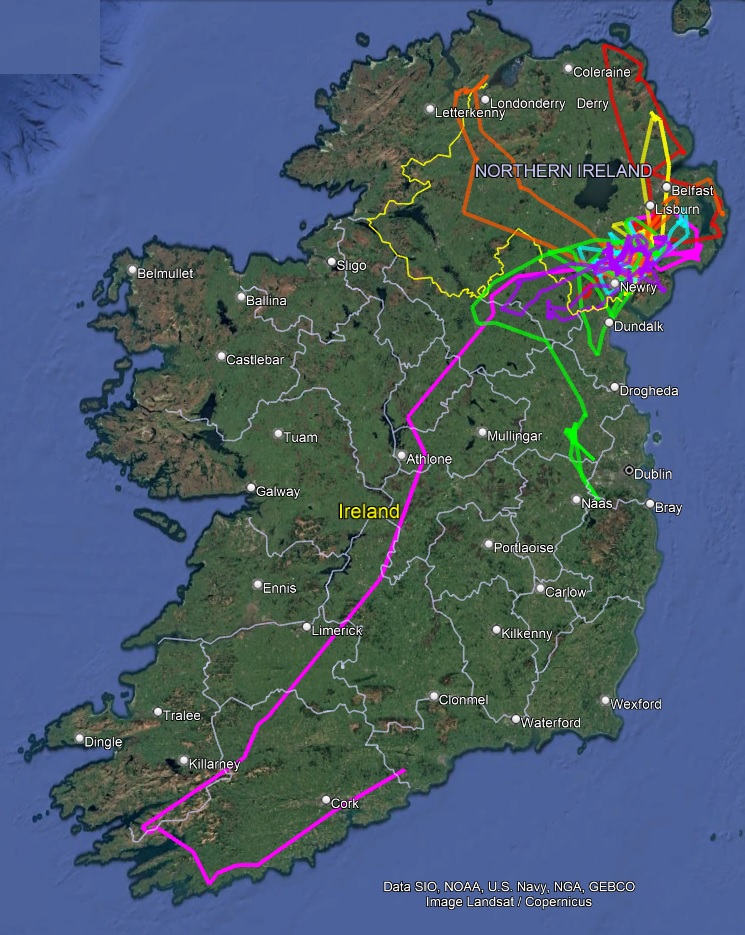
We will take a closer look at the movements of some of the most adventurous individuals over the coming months. We wish them all well on their exploratory travels!
Keep your eyes peeled for red kites this winter and report any sightings to www.nirsg.com/sightings or https://forms.office.com/r/k7rdt4JQRY
 Hawk-Eyes
👍👍👍
LikeLike